I’ve practiced wildlife friendly gardening for years and am lucky enough to have a garden adjoining open countryside and have seen an excellent range of wildlife from it over the years. I plant native or pollinator friendly plants, don’t mow the lawn until the autumn, have a pond, have log piles and leave leaf litter piles through the winter and don’t use pesticides. The lawn has never been enriched with any form of fertilizer or other nutrients in the twenty years we’ve been here either. However, I still think there’s more I can do so this year I’ve got a few additional mini-projects planned or already underway.
The first of these is a wildflower meadow in the lawn. The lawn is about 15m long and between 5 and 7 metres wide, and in previous years I’ve not mown the majority of it before the end of August, keeping only a closely mown path down the centre, and a mown area near the house where access is needed for the washing line. This gives it a natural but not unkempt appearance. I’ve thrown the odd packet of seed in from time to time to see what takes with mixed success but there are quite a few wildflowers becoming established including Birds-foot Trefoil, Ragged Robin, Wood Forget-me-not, Common Sorrel, Self-heal, Dandelions, Daisies, Primroses and Oxlips and probably a few others that I’ve not spotted.
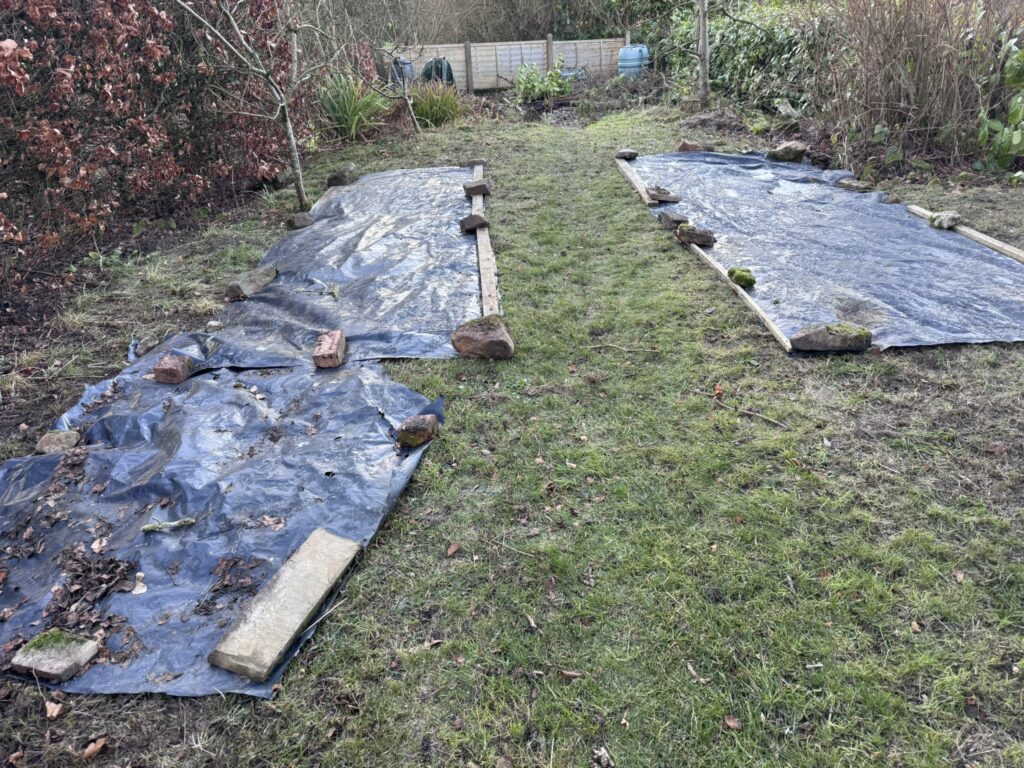
However the lawn is still heavily dominated by grasses and lacks species diversity. I think it can be improved, so this year I’m conducting an experiment. I’m killing off two patches of grass either side of the central path totalling 13m2 with black plastic sheet that I put down at the end of December. This will remain in place until early March when the hopefully bare ground will be seeded with a wildflower seed mix.
I’ve already got the see mix which is currently in a mix of damp sand and soil and is cold-stratifying in the fridge. This should help germination of some of the seeds particularly Yellow Rattle which I’m hoping to get established to tame the grasses.
I got the seed mix from Landlife Wildflowers and chose the restore and enrich mix which hopefully will do well on my exposed slightly acidic heavy soil.
Here’s the species mix. Some of these are already established in the lawn, so if the rest of the species do well in similar conditions I should get some good results and looking at the eventual height of some of these they should compete well against the grasses, which usually reach 80-100cm.
| Species | Latin Name | Percent of mix | Flowering period | Eventual height | Type |
|---|---|---|---|---|---|
| Bedstraw, Lady’s | Galium verum | 5% | Jun – Sep | 50 – 80cm | Perennial |
| Black Medick | Medicago lupulina | 3% | May – Oct | 15 – 80cm | Annual |
| Burnet, Salad | Sanguisorba minor | 5% | Jun – Sep | 15 – 50cm | Perennial |
| Buttercup, Meadow | Ranunculus acris | 6% | May – Jun | 30 – 100cm | Perennial |
| Campion, Red | Silene dioica | 6% | Apr – Sep | 60 – 90cm | Perennial |
| Campion, White | Silene alba | 5% | May – Oct | 50 – 100cm | Perennial |
| Carrot, Wild | Daucus carota | 4% | Jun – Oct | 30 – 100cm | Perennial |
| Chamomile, Corn | Anthemis arvensis | 3% | Jun – Jul | 30 – 50cm | Annual |
| Corn Cockle | Agrostemma githago | 9% | May – Aug | 50 – 70cm | Annual |
| Cornflower | Centaurea cyanus | 4% | Jun – Oct | 20 – 80cm | Annual |
| Daisy, Ox-eye | Leucanthemum vulgare | 5% | May – Sep | 20 – 100cm | Perennial |
| Goatsbeard | Tragopogon pratensis | 4% | Jun – Aug | 30 – 90cm | Perennial |
| Knapweed, Common | Centaurea nigra | 7% | Jun – Sep | 30 – 80cm | Perennial |
| Marigold, Corn | Chrysanthemum segetum | 3% | Jun – Oct | 30 – 50cm | Annual |
| Meadowsweet | Filipendula ulmaria | 3% | Jun – Aug | 80 – 200cm | Perennial |
| Poppy, Common | Papaver rhoeas | 1% | May – Jul | 50 – 70cm | Annual |
| Scabious, Field | Knautia arvensis | 2% | Jul – Sep | 30 – 200cm | Perennial |
| Self-heal | Prunella vulgaris | 5% | Jun – Sep | 15 – 30cm | Perennial |
| Sorrel, Common | Rumex acetosa | 5% | May – Jul | 30 – 100cm | Perennial |
| Trefoil, Bird’s-foot | Lotus corniculatus | 3% | Jun – Aug | 10 – 40cm | Perennial |
| Vetch, Tufted | Vicia cracca | 2% | Jun – Sep | 100 – 150cm | Perennial |
| Yarrow | Achillea millefolium | 2% | Jun – Oct | 20 – 100cm | Perennial |
| Yellow Rattle | Rhinanthus minor | 8% | Jun – Sep | 25 – 50cm | Annual |
The other preparation I’ve done was to mow the rest of the lawn as short as possible and hard rake the remaining grass. This pulled up a lot of material including the grass that had died back from last summer and quite a bit of moss. This should help light to reach the soil and help any existing seeds to get a chance against the grasses – although there will be quite a lot of grass seed in there too, which is fine.
I will be setting up a camera to take a time-lapse of the meadow’s progress during the year and will be monitoring some environmental parameters with a Raspberry PI and some sensors – just for fun, but I might learn something too.
Upcoming posts will cover the setup of the Raspberry Pi and the camera and sensors and progress on the meadow.