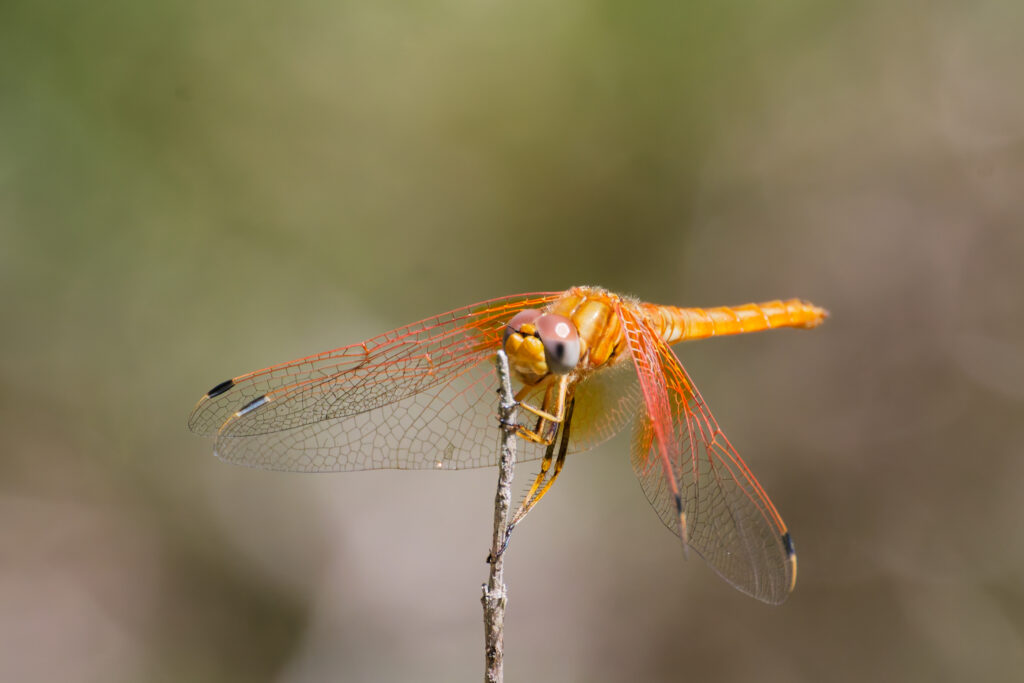
This is my first Orange-winged Dropwing which gave me an identification challenge. I’m in Ibiza with no dragonfly id guides or apps, so I’m relying on my own sketchy knowledge of southern European species. My first thoughts were a female or teneral male Red-veined Darter due to the eye-colour. RVDs have the pale blue-green coloration to the lower part of the eye. However, they also have pale pterostigma and on this specimen they are clearly black. I ran through the other “red” darter species but none came close for one reason or another but Google suggested this species. After looking at a few images I was happy to identify it as such and upon loading to iNaturalist it was confirmed with the good quality photo attached and classified as a research grade observation. Nice.
Incidentally, in the absence of any field guides I took a chance on AI asking Claude for a list of the diagnostic features of the “red” darter species likely to be found in southern Europe in April. However, it was far too eager to misidentify and jump to incorrect conclusions based on what identification information I’d typed. I emphasised the pterostigma colour, eye colour, and coloration of the wings and veins as key features, but it just seemed to ignore what I’d said. It’s clear that AI in its current evolution is someway short of being a reliable reference source for identification.
It’s been a wet winter on Ibiza and the island is very green. Wildflowers are out in abundance and there has been an explosion of invertebrate life. I’ve seen more Red-veined Darters this week than I’ve ever seen, and if the thousands of Painted Lady’s seemingly everywhere it could be an “Painted Lady Year” in northern Europe this year. There are also quite a few Clouded Yellows, Vagrant Emperors and many more inverts whose identification I’ve yet to get to grips with.